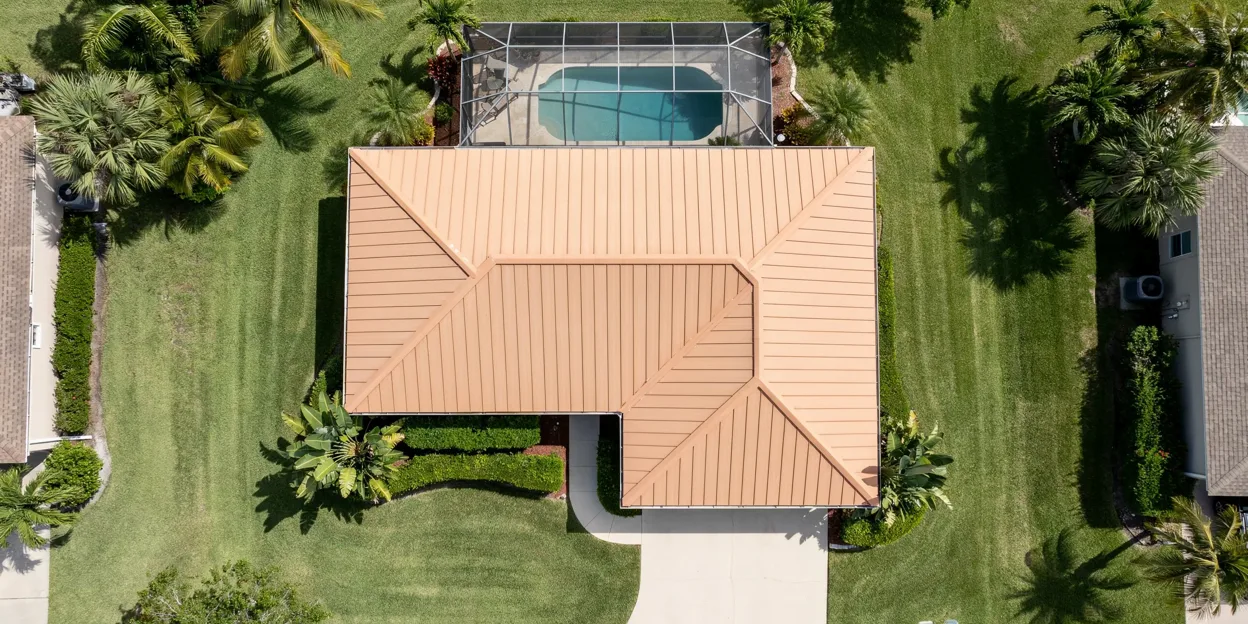
The house on the river has had three shingle roofs since 1971, and every one of them started losing granules on the east slope within ten years. The neighbor two doors down put on standing-seam metal after Matthew and has not thought about the roof since. This site connects you by phone with an independent local roofing contractor who installs and repairs metal roofs in north Brevard County.
The contractor looks at exposure before anything else. A riverfront lot on US-1, a house in the open on a Mims pasture, and a shaded street in Port St. John are three different jobs. For anything near the lagoon they specify aluminum or a coastal-rated coated steel, stainless or coated fasteners, and sealed cut edges, because salt air attacks the screws and the edges years before the panels wear out.
Then the deck. Metal over a 1960s plank roof needs the boards checked and re-nailed, and in most cases a solid underlayment or a plywood overlay before panels go on. The scope names the panel profile, the gauge, the coating, the fastener type, and the wind rating from the product approval.
Find out what is on the roof now and how old it is. If there is an existing metal roof that is leaking, note where: at a screw line, at the ridge, at a wall, or at a skylight. Walk the property and list the outbuildings, because a barn or workshop roof is real work here and changes the scope.
Decide whether you care about the look of the seams. Standing seam hides the fasteners and handles heat movement without stress at the screws. Exposed-fastener panels are simpler to install and put hundreds of gasketed screws on the weather side, each one a future maintenance item. That trade should be a decision you make, not a surprise you find.
On an existing metal roof, most leaks are fasteners that have backed out or lost their washers, closures at the ridge that have failed, or flashing at a wall or chimney. Those are repairs: screws replaced with oversized ones, closures redone, sealant renewed. Panels lifted at a corner by wind are reset or replaced one at a time.
A metal roof with rust through the panels, or an old exposed-fastener roof where every screw line leaks, is a replacement. A shingle roof being converted to metal is a full roof replacement with the deck brought to code first, and on a space-boom house that means the older home work comes before the panels.
Titusville sits between the Indian River Lagoon and the longest stretch of undeveloped Atlantic beach in Florida at Canaveral National Seashore, and the air moving between them carries salt across the whole corridor. Metal earns its place first along US-1 and on the north end of Merritt Island. Inland, in Port St. John and the west side of Titusville, shingle still does the job for most owners, and the choice is about how long you plan to own the house.
Mims and Scottsmoor have more metal than anywhere else in the county, on homesteads, on newer homes on acreage, and on barns. The common split out there is standing seam on the house and exposed-fastener panel on the outbuildings. Metal also carries a wind rating that shows up on the wind-mitigation form, and its expected life pushes back the roof-age question carriers ask at renewal.
Have the address and say whether it is riverfront, rural, or in a neighborhood. Say what is on the roof now, whether there are outbuildings, and whether you are repairing an existing metal roof or replacing shingle with metal. Call (321) 490-0701.
 Standing by
Say it in plain words. The call is routed to an independent local roofing contractor who works shingle, metal, and flat roofs on the older homes and rural lots of north Brevard County.
The state wind-mitigation inspection form, and the deck nailing, straps, and secondary water barrier that earn credits on it during a reroof.
Reroofing 1960s space-boom homes: plank decking, low-slope hips, flat sections, and the code upgrades the permit requires.
What to photograph, what a contractor's written scope gives the adjuster, and how Florida's roof-claim rules work after a storm.