
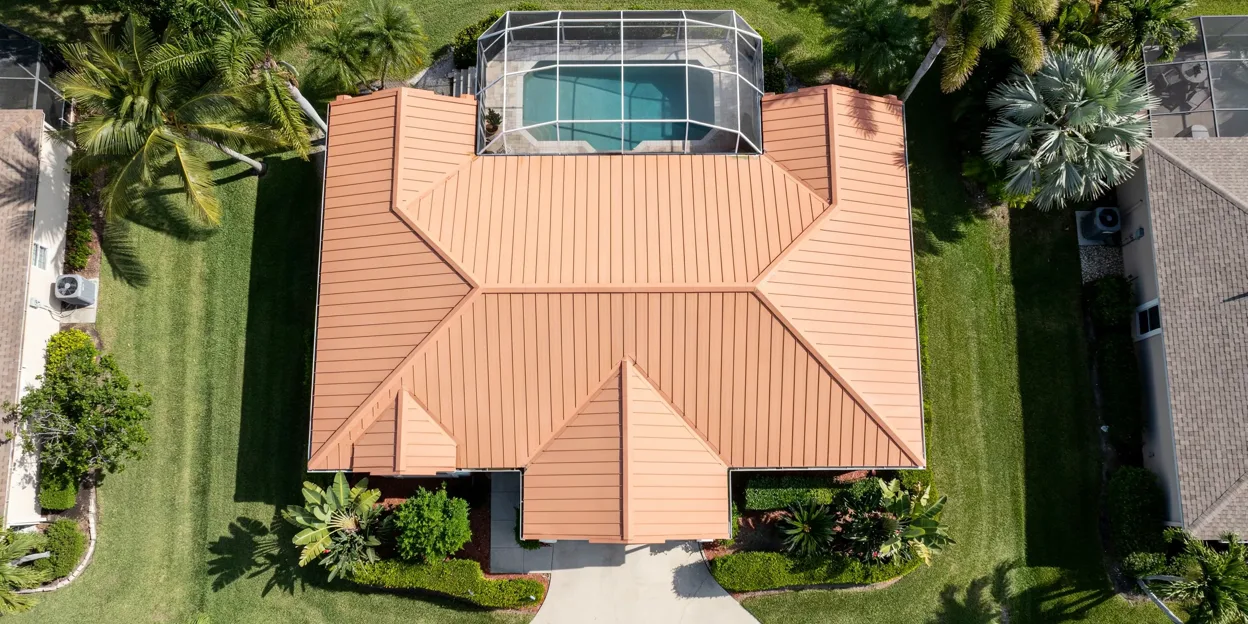
The rain came through at four, the way it does all summer, and by half past there was a drip on the hallway floor of a house that has stood on the same Whispering Hills street since 1963. It stopped when the rain stopped. It will start again tomorrow at four. This site connects you by phone with an independent local roofing contractor who repairs roofs in north Brevard County.
The contractor walks the roof and looks at the attic side before quoting anything. On a low-pitch 1960s hip roof, the leak is rarely where the drip lands. Water gets in at a valley where the metal has rusted, at a pipe boot that has split in the sun, at a shingle lifted by wind off the river, or where the old shingle meets the flat roof over the Florida room, then runs along a plank and drops at the first gap it finds.
Once the entry point is found, the fix is scoped to that area. A run of shingles replaced and sealed. A new boot around a vent. Valley metal cut back and redone. Flashing at the chimney or a wall reset. A soft board under the leak cut out and replaced. The contractor writes down what was found and what was done, with photos.
Put a bucket under the drip and move anything that cannot get wet. If the ceiling is bulging, stay out from under it and do not poke it. If the drip is near a light fixture, turn off that circuit at the panel. Take photos of the stain from below and, if you can reach the attic hatch safely, of the wet spot from above.
Stay off the roof. A 1960s plank deck with a leak over it can have a soft spot that does not show from the ladder, and a low-pitch roof feels walkable right up until it is not. If water is coming in fast during a storm, ask about a tarp when you call.
A roof with sound decking and damage in one place is a repair. That covers most wind damage after a single storm, most boot and flashing failures, and most valley leaks. A flat Florida-room or carport section that is leaking at a seam is often a repair to that section alone, with a membrane or roll roofing, while the pitched roof stays as it is.
A roof with soft boards in several places, shingles that crumble when lifted, or granules gone from every south-facing slope is past repair. Florida's 25 percent rule also matters here. Roofs permitted before March 2009 that need more than a quarter of a section repaired within a year have to bring that section up to current code, which usually means roof replacement. Most Titusville reroofs from the 1990s fall under that older rule.
The 1960s homes carry one set of problems: gapped plank decking, valleys that were never replaced through two reroofs, and flat sections where shingle was used on a slope too low for it. Port St. John's 1980s and 1990s shingle roofs carry another: lifted tabs on the side that faced the wind during Matthew or Milton, and boots that have cooked in the sun for thirty years. Mims and Scottsmoor metal roofs leak at fasteners and at the ridge closures, and the fix is often screws and sealant rather than panels.
A repair in Brevard County may or may not need a permit, depending on how much of the roof is touched. The contractor knows the threshold for the city and for the county. If a renewal letter is on the counter anyway, the same visit can produce the written findings for a roof inspection.
Have the address and say whether water is coming in right now. Be ready to say the year the house was built, what kind of roof it is, and whether the leak started with a storm. Say whether the ceiling is stained, sagging, or dripping. Call (321) 490-0701.
 Standing by
Say it in plain words. The call is routed to an independent local roofing contractor who works shingle, metal, and flat roofs on the older homes and rural lots of north Brevard County.
Tear-off to the deck, plank boards checked and replaced where soft, new underlayment, and a new roof permitted through the city or Brevard County.
Tarping, photos, and repair after wind off the lagoon, a fallen oak, or a named storm crossing the Space Coast opens the roof.
A walk on the roof and a look in the attic, written up with photos for a renewal letter, a home sale, or a check before June 1.