The wind came off the river all night, and at first light there are shingle tabs on the lawn and daylight showing through the carport ceiling. The next rain band is on the radar. This site connects you by phone with an independent local roofing contractor who handles storm damage in north Brevard County.
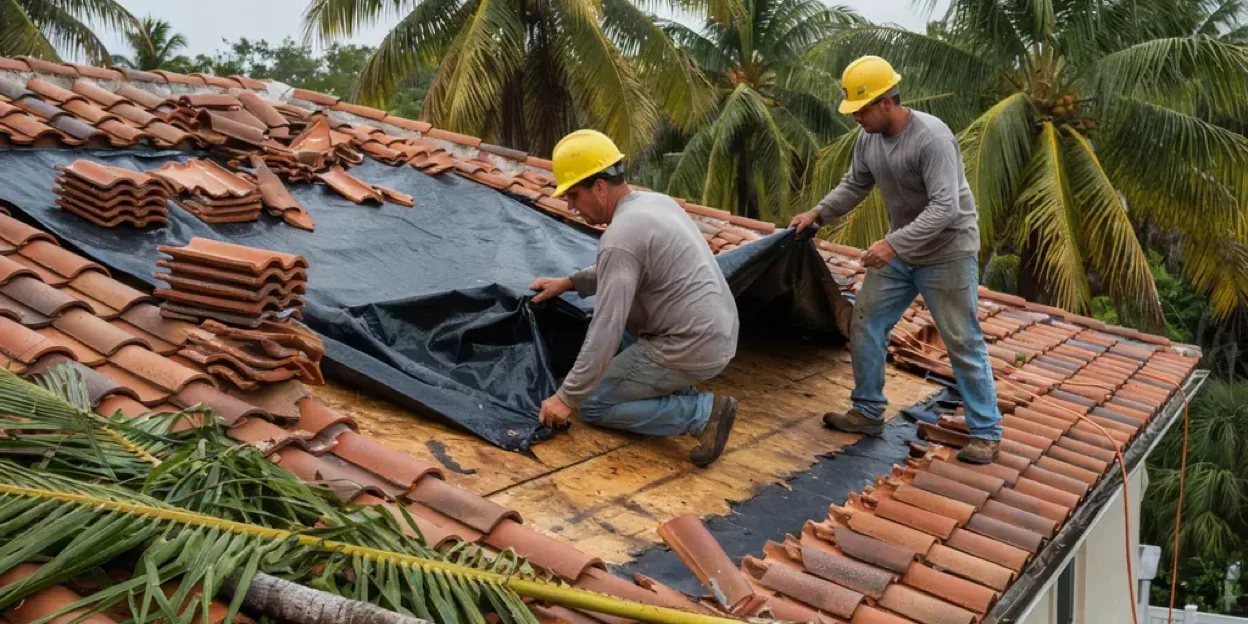
The first job is to stop the water. The contractor tarps the opening or dries it in with underlayment and battens, and photographs every damaged area before it is covered. Then they walk the whole roof, not just the spot you can see from the driveway, because wind that lifts tabs on one slope has usually creased shingles on the others. On a metal roof they check for panels lifted at the eave and screws pulled through. On a flat section they look for the membrane peeled back at the edge.
What they write down is what the storm did: which slopes, how many squares, whether the deck is exposed, whether the plank boards under the opening are wet. That is separated from what was already worn, because an adjuster will separate it too.
Photograph everything from the ground and inside before anything is moved: the yard, the roof from each side of the house, the ceiling, the attic if you can reach it safely. Get the opening covered and keep the receipt; your policy requires you to prevent further damage, and emergency protection is normally part of a claim. Call your insurer and get a claim number.
Stay off the roof. A storm-damaged 1960s deck can have soft boards that were fine yesterday. Do not sign anything a person at the door hands you, and do not sign a document that assigns your insurance benefits to anyone. Florida ended that practice for residential policies issued since 2023, and a contractor asking for it on a current policy is asking for something the law no longer allows.
Lifted and creased shingles on one or two slopes, a torn section of flat roof, a fallen oak limb through the deck, and metal panels peeled at one corner are roof repairs once the water is stopped. A roof that lost shingle on every slope, or a 1990s roof where the storm finished what age had started, is a roof replacement, and Florida's 25 percent rule for roofs permitted before 2009 often decides it.
Titusville's storm history is a list of roofs. Frances stalled over Brevard in early September 2004 with hours of hurricane-force gusts, and Jeanne came three weeks later and pulled the tarps off. Matthew ran up the coast just offshore on October 7, 2016, with gusts past 100 mph at the Cape, and tore the roof off an apartment building in Titusville. Irma in September 2017 damaged more than 7,000 homes in the county and put the Indian River into Sand Point Park. Ian exited the state just north of the Cape on September 29, 2022, after dropping up to a foot of rain on the north county. Milton's eye crossed between Titusville and Kennedy Space Center overnight on October 9, 2024, with gusts of 50 to 80 mph, and peeled roofing off a commercial building on US-1.
The riverfront along US-1 takes wind straight off the lagoon. Mims and Scottsmoor homes sit on open land with nothing to break a gust. The older the roof, the lower the wind speed at which it starts to shed. Brevard County Emergency Management posts evacuation zones and shelter openings, and reading it in May beats reading it during a watch. After the storm, the insurance claims page covers what the adjuster will want.
Have the address and say whether water is coming in now. Say when the storm hit, whether the roof is tarped, what kind of roof it is, and whether a tree is involved. Have your claim number if you already have one. Call (321) 490-0701.
 Standing by
Say it in plain words. The call is routed to an independent local roofing contractor who works shingle, metal, and flat roofs on the older homes and rural lots of north Brevard County.
A walk on the roof and a look in the attic, written up with photos for a renewal letter, a home sale, or a check before June 1.
Standing-seam and exposed-fastener metal for riverfront, rural, and outbuilding roofs, specified for salt air off the Indian River.
The state wind-mitigation inspection form, and the deck nailing, straps, and secondary water barrier that earn credits on it during a reroof.