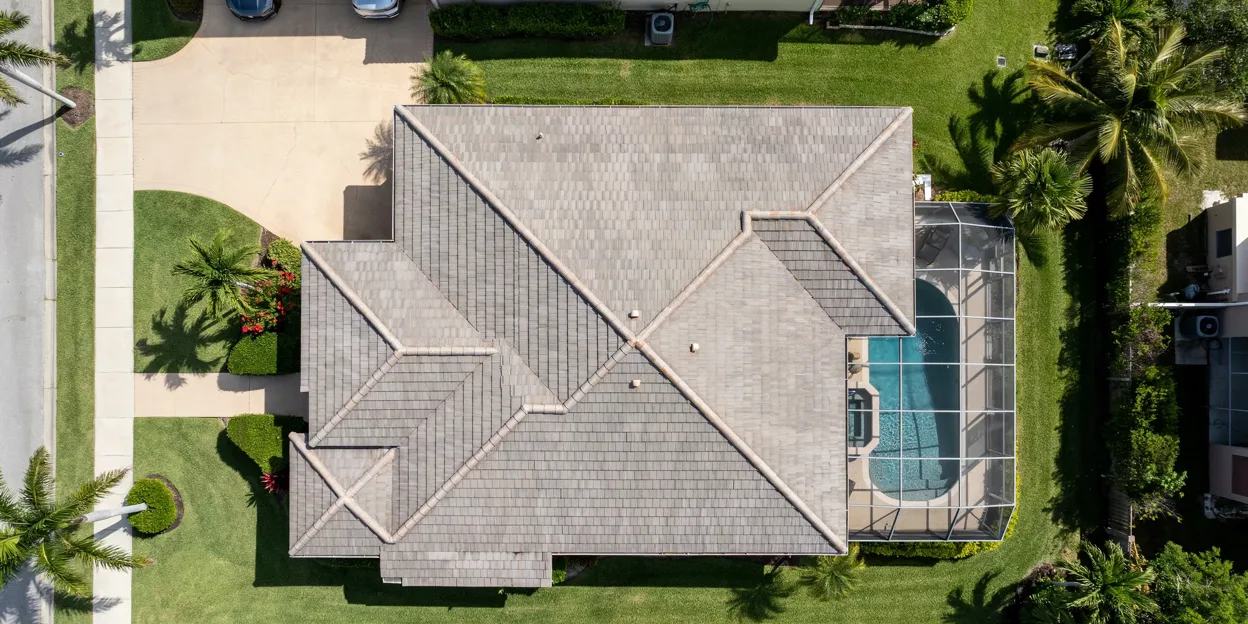
Indian River City was its own town on the river south of Titusville until the early 1960s, when the city absorbed it during the space boom. The name survives on the neighborhoods along South Washington Avenue and the streets running west from it, between the old downtown and the Port St. John line. The housing is what the 1960s built: concrete block ranches with low hip roofs, jalousie-window Florida rooms under flat roofs, and carports, on lots that were groves a decade earlier.
Most of these homes have had two or three roofs. The current one is usually shingle from the 1990s over the original plank deck, and it is the roof the renewal letters are about. The riverfront streets take wind off the lagoon, and Irma in 2017 pushed the river up over the parks along this stretch.
This site connects Indian River City homeowners with an independent local roofing contractor by phone. It does not perform the work.
A 1965 ranch with a stain in the hallway is a roof repair that starts with a look at the boards from the attic. A roof that is done on that same house is an older home roofing job, with the flat section scoped separately. A renewal letter is a roof inspection first.
These addresses are inside the Titusville city limits, so permits go through the city's building department. The neighborhood's river park is Kennedy Point Park on South Washington Avenue, a county park with a boat ramp and a shoreline walk that looks straight across at the launch pads.
Call (321) 490-0701 to be connected with a local roofing contractor serving Indian River City.
A lifted shingle, a rusted valley, a split pipe boot, or a drip that shows up with every afternoon storm, traced to its source and fixed.
Tear-off to the deck, plank boards checked and replaced where soft, new underlayment, and a new roof permitted through the city or Brevard County.
Tarping, photos, and repair after wind off the lagoon, a fallen oak, or a named storm crossing the Space Coast opens the roof.
A walk on the roof and a look in the attic, written up with photos for a renewal letter, a home sale, or a check before June 1.
Standing-seam and exposed-fastener metal for riverfront, rural, and outbuilding roofs, specified for salt air off the Indian River.
The state wind-mitigation inspection form, and the deck nailing, straps, and secondary water barrier that earn credits on it during a reroof.
Reroofing 1960s space-boom homes: plank decking, low-slope hips, flat sections, and the code upgrades the permit requires.
What to photograph, what a contractor's written scope gives the adjuster, and how Florida's roof-claim rules work after a storm.